 (718) 555-0142
Staten Island · Ages 8 to 14
Faster hands. Quicker feet. And the numbers to prove it.
A twelve week reaction and hand eye program for young athletes in baseball, basketball, tennis and soccer. Coached by Fares Ezziddin, a former professional and Division I college coach.
45 minutes. You leave with your child's numbers on paper. Applied in full toward the semester if you enroll.
Hero video
10 to 15 seconds of a kid mid rally with the laser gates firing. Autoplay, muted, loop, compressed hard. Poster frame required.
The insight
Every youth program trains the swing. Almost none of them train the reaction.
Your kid has a hitting coach, or a shooting coach, or a private trainer. All of that works on the movement itself.
What almost nobody works on is the quarter second before the movement. Seeing it early. Deciding faster. Getting the first step down before the other kid does.
That quarter second is trainable. It is also measurable, which means you can watch it improve instead of taking somebody's word for it.
That is the only thing we do here.
The coach
Photo of Fares on court
Real photo, good light, no stock. This section fails without his face.
Who your kid trains with
Fares Ezziddin coached professionally and spent time as a Division I assistant at Miami University in Ohio before opening Reaction Lab.
He built this place because after years of coaching he kept seeing the same gap. Talented kids with slow eyes. Kids who could execute perfectly in a drill and were half a beat late in a game. Nobody was training that, and nobody was measuring it, so nobody could prove it was getting better.
Reaction Lab is the first commercial facility of its kind in the United States. It is a small room in Charleston with a court, six reaction modules, laser timing gates, and a maximum of four kids on the floor at once.
He coaches every session himself.
What actually happens
One hour. Almost no standing around.
Sessions run on a 39 foot court with foam balls and short racquets. That is deliberate, and it is the part parents find surprising.
A smaller court means roughly three times the touches of a full sized one. Rallies last longer, points come faster, and there is no line to stand in. A child who has never held a racquet is rallying inside the first fifteen minutes, which almost never happens in a conventional lesson.
Your kid is not here to become a tennis player. The court is the tool. It is the fastest way we have found to make a young athlete's eyes and hands work together under pressure, and it carries straight back to whatever sport they actually play.
01
Assess
Laser gates and reaction modules measure first step speed, change of direction and reaction time. Every kid wears an NFC band, so nothing is written down by hand.
02
Train
Four to one, coach to athlete. Live rallies, gated drills, and gamified one on one rounds with a leaderboard. High tempo the whole hour.
03
Retest
Every four weeks the same tests run again, against their own baseline and against the group.
The report
You get the data, not just a thank you at pickup
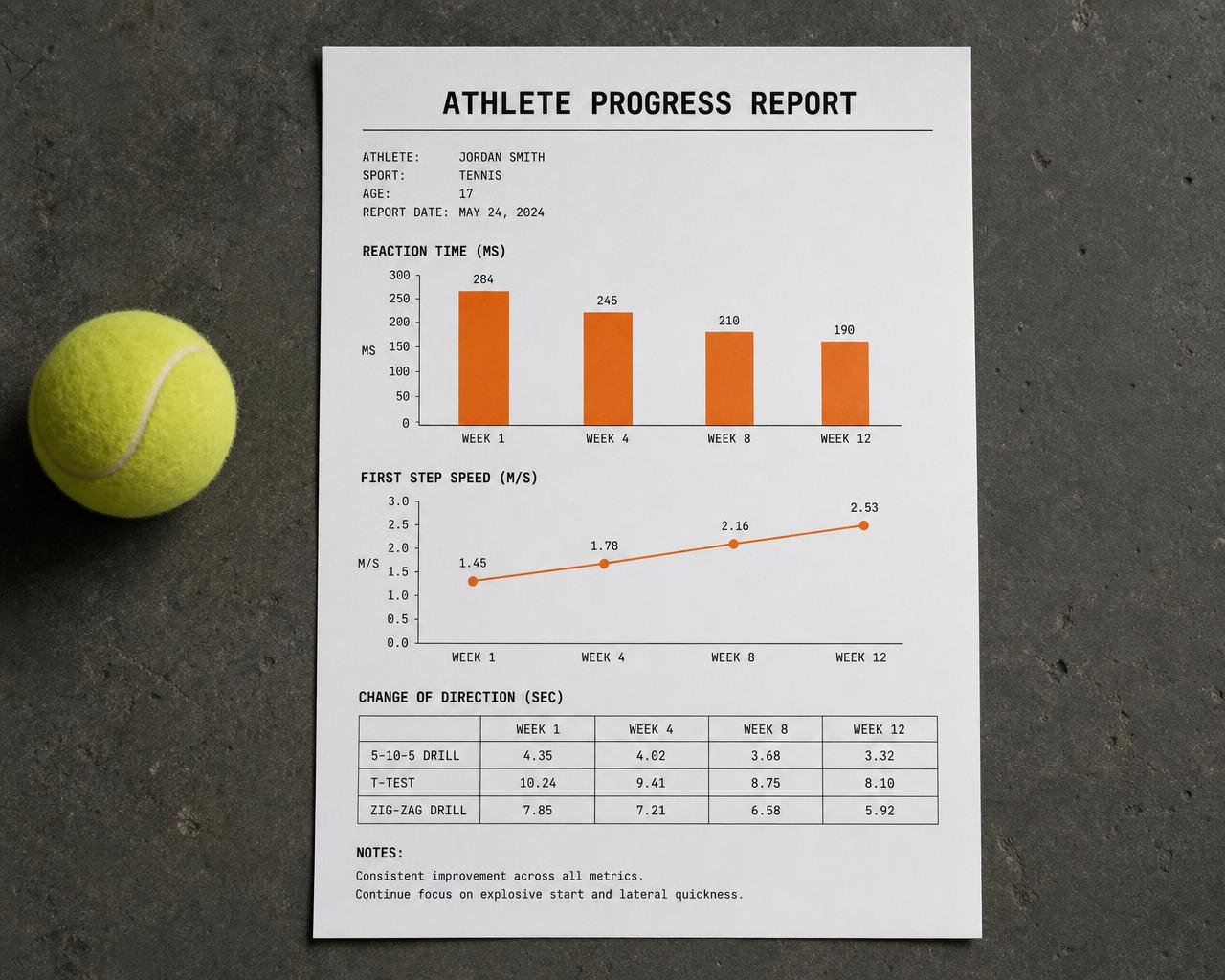
At weeks one, four, eight and twelve, your child is retested on the same equipment under the same conditions. You get a report showing what changed.
Reaction time in milliseconds. First step speed. Change of direction. Where they started, where they are now, and how they compare to the rest of their group.
Most youth sports asks you to trust that it is working. This one shows you.
Who it is for
Built for the kid who already plays something
Baseball and softball
Pitch recognition and reaction at the plate. The hands catch up to what the eyes already saw.
Basketball
First step, change of direction, and reading a defender earlier.
Tennis
Volley hands, footwork, and three times the touches per hour of a conventional lesson.
Soccer, hockey, lacrosse
Anything where the ball arrives faster than you can plan for.
No racquet experience needed, and most of our athletes have none. Beginners rally in the first fifteen minutes.
The program and price
The Twelve Week Semester
$840
Twelve weeks · one hour a week
Or three payments of $300.
- Twelve coached sessions, four athletes maximum
- Full assessment at week one
- Retesting at weeks four, eight and twelve
- Four progress reports
- All equipment provided
- Coached by Fares
Start smaller
Not ready to commit to twelve weeks? Start with a $49 assessment. Forty five minutes, you leave with the numbers, and the $49 comes off the semester if you enroll.
Book the assessmentPractical
The details
Where
202 Industrial Loop, Bay C
Staten Island NY 10309
Free parking directly outside. Fifteen minutes from Great Kills, ten from Tottenville.
When
Unconfirmed
Insert the real class days and times. This is the single most important field on the page. A parent who cannot find a time that fits does not fill in the form.
Questions parents ask
Questions parents ask
My kid has never played tennis. Is this the wrong fit?
It is the right fit. Most of our athletes come from baseball, basketball or soccer and have never held a racquet. The foam ball and the short court exist so that beginners rally almost immediately.
Is this going to replace their sport?
No. It is an hour a week, and it is built to make them better at the sport they already play.
How many kids in a session?
Four, maximum. Fares coaches every one himself.
What does my kid need to bring?
Court shoes and water. Racquets and balls are provided.
What if we start and it is not for us?
Book the $49 assessment first. Forty five minutes, no commitment, and you will know.
How old does my child need to be?
Ages 8 to 14. [Placeholder — confirm the real range before this runs.]
Book
Start with 45 minutes and a set of numbers
Book an assessment. Your child runs the same tests our semester athletes run, and you leave knowing exactly where they stand. If you enroll, the $49 comes off the semester.